

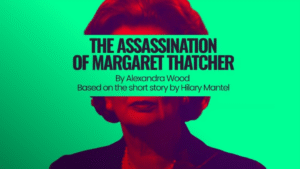
Preview: The Assassination of Margaret Thatcher — Liverpool Everyman (2–23 May 2026)
History doesn’t always arrive with fanfare. Sometimes it slips in quietly, through a half-open window, carrying something far more dangerous. This May,
There’s a particular kind of alchemy required to approach the catalogue of Bob Dylan without either genuflecting into museum-piece reverence or collapsing into pub-band pastiche. At The Bijou, John O’Connell’s Simply Dylan thread that needle with a confidence born not of imitation, but of complete immersion.
From the outset, O’Connell (vocals, guitar, banjo, raconteur) makes good on the group’s oft-repeated maxim: “a tribute to Bob Dylan, not a Bob Dylan tribute.” This is a classy celebration of the bard, not an attempt in any way to dwell on Dylan’s idiosyncrasies. There’s no nasal curl from O’Connell, no intense aloofness, no shadowboxing with the ghost of Hibbing. Instead, he delivers the songs – and that’s the key thing to remember with this acoustic quartet, the songs – in a robust, grain-rich voice, supported by an outstanding and accomplished set of supporting musicians. They are a lean, intuitive ensemble, comprising the mesmerising Kath Ord (violin, saxophone, backing vocals), an instinctive and technically brilliant Treva Goldup (guitar, mandolin, harmonica), and dextrous, metronomic Helen Seymour (bass). Each member, throughout the gig, bring colour and muscle in equal measure. Ord, in particular, plays like she’s wandered in from the Desire sessions in 1975.
And so, with Simply Dylan, the songs of Bob Dylan are treated as repertory, not relic. The night begins, much to my delight, with the infectious Tangled Up in Blue from, arguably, Dylan’s finest album ever, Blood on the Tracks (1975). It’s an interesting version in which Simply Dylan sidestep the song’s studio mutability (the famously re-recorded New York-to-Minneapolis shift) and instead lean into its narrative elasticity. O’Connell phrases it less like confession and more like campfire mythology, and I can tell that the room has swollen towards the sound. My mate Greg – himself a local musical maestro – has been threatening to bring me out to see O’Connell for several years, and now I realise why. It’s a welcome assault on the senses.
By the time Simply Dylan tumble into Lily, Rosemary and the Jack of Hearts (same album, same year), that sense of storytelling-as-spectacle is in full bloom, and every foot in the room is starting to dance. Eight minutes that can sag in lesser hands becomes, here, a violin-streaked frontier drama, with Ord’s bow practically casting shadows on saloon walls. She Belongs to Me (1965, Bringing It All Back Home) is all sly shrug and electric-era insouciance, while I Want You (1966, Blonde on Blonde) arrives featherlight, its surrealist courtship reframed as something almost giddy. I was obsessed with this song in college, and it provided the soundtrack to a very (un)memorable night in a local nightclub where the love of my life at that time sent me packing.
There’s a pleasing refusal to fossilise Dylan’s so-called “classic trilogy” period with Simply Dylan. Instead, these songs breathe, and between numbers the show is infused with the type of salt-of-the-earth wit and humour you’d come to expect from a band fronted by a Scouse lad.
A real standout moment hits early in the first set when the band deliver a stunning version of Señor (Tales of Yankee Power) from 1978’s Street-Legal. One of my all-time favourite Dylan masterpieces, the band brings a different hue. Borderline apocalyptic, born of Dylan’s late-’70s spiritual and political unease, it’s a song that feels like reading a classic novel, and O’Connell delivers it accordingly. Here, Goldup’s mandolin lines snake around Ord’s violin, conjuring that desert-night ambiguity Dylan himself seemed to inhabit in the Street-Legal era.
Then comes the pivot. The Ballad of Hollis Brown, from The Times They Are a-Changin’ (1964), was written when Dylan was barely out of his teens, yet already channeling Appalachian fatalism. O’Connell delivers it starkly and without melodrama, and I find myself bewitched by the ease in which he holds these songs in his palms. It’s a great performance of an often forgotten Bob song, and a reminder of Dylan’s early absorption of folk tradition. Shelter from the Storm (1975) comes next, which is a treat for me since it’s another of my staple favourites from the only singer-songwriter ever to win a Nobel Prize. Arguably Dylan’s most tender benediction, it’s a beautifully subtle and emotive version from a band that are completely inside these songs. In Lay Lady Lay (Nashville Skyline, 1969) O’Connell sings it in his own style completely, which gets me musing more so about what this show actually is – a celebration, not a parody. It rolls in with its country croon origins intact, but given a slightly more melodic, Merseyside grain.
Set one closes with When the Ship Comes In from Dylan’s landmark third album, The Times They Are a-Changin’ (1964); that Biblical, almost Old Testament vision of reckoning. It was written, legend has it, after Dylan was denied a hotel room. Here, it lands like a quirky pub singalong with prophetic undertones, and the band disappear into the bar for a much-earned break.
O’Connell particularly is a curious character. It’s pretty hard to take your eyes off his craft, with every single note both considered and executed with skill. The band are equally as accomplished, too, which means a rich organic blend of talent.
Set two, though, broadens the lens. Love Minus Zero/No Limit is the opener from Bringing It All Back Home (1965), and is handled delicately with its imagery (clocks, ravens, valentine cards) allowed to shimmer in a room full of anticipation. Then Simply Dylan take on something a little bit more contemporary but equally as weighty – Things Have Changed – a song from the film, Wonder Boys. This is Dylan as a late-career ironist; proof that the man’s mordant wit survived every reinvention. It’s a bluesy rendition, and Treva Goldup really shines. What a player he is.
Desolation Row, from 1965’s Highway 61 Revisited, is the evening’s high-wire act, and upon O’Connell announcing it, greeted with a cheer. Eleven minutes of grotesques and literary cameos – Cinderella, Ophelia, Dr. Filth – held together by O’Connell’s unflappable delivery, and the sublime textures of Kath Ord. Where Dylan’s own live versions often mutate beyond recognition these days, this one honours the studio structure with that extra live gallop. A hushed Boots of Spanish Leather from The Times They Are a-Changin’ (1964) – a transatlantic love letter steeped in traditional folk melody – finds O’Connell and Ord in poignant dialogue, before You’re Gonna Make Me Lonesome When You Go, another cut from Blood on the Tracks (1975) restores a breezier tone.
Now, I’ve never been a fan of Knockin’ on Heaven’s Door, Dylan’s 1973 song from Pat Garrett & Billy the Kid. It’s become one of those songs that feels like an itch, or a complete inconvenience. It’s in a batch with the likes of Chuck Berry’s Johnny B. Goode, Lynyrd Skynyrd’s mind-numbing Sweet Home Alabama, Sweet Caroline by the otherwise superb Neil Diamond, and (Everything I Do) I Do It for You by Bryan Adams, which basically ruined everyone’s childhood in my generation. These are all songs that hopeless pub bands just starting out end up covering, and though communal, tend to get on the nerves of most. I’m surprised that Simply Dylan cover it, since they are much more in the business of deep cuts, but they do a pleasant version nonetheless. O’Connell’s powerful version of A Hard Rain’s A-Gonna Fall (The Freewheelin’ Bob Dylan, 1963) reminds you that Dylan, at 21, was already writing songs that felt like scripture born of Cold War subconscious.
Come (Quinn the Eskimo) The Mighty Quinn, from (arguably) one of Dylan’s duds, Self Portrait (1970), turns the room buoyant, and they keep the song’s deliberate looseness and jamboree intact. To Ramona, a lovely pastoral sigh from Another Side of Bob Dylan (1964) drifts in at the request of several audience members. O’Connell laughs off a request for Hurricane, and I’m almost relieved for him. The inevitable closing stretch: Don’t Think Twice, It’s All Right, one of the outstanding tracks from The Freewheelin’ Bob Dylan (1963), is delivered solo by O’Connell, and executed with mastery. Wanted Man is a surprise – a song Cash first released on his 1969 live album At San Quentin, but penned by Dylan. It’s a nice closer though, and hand claps guide it home.
Despite being at The Bijou since 3pm setting up and mastering the sound, Simply Dylan are implored to play more. They are not reluctant. We are all there for the music, so why not have more?
Like a Rolling Stone is an inevitable, encore rouser. Highway 61 Revisited was an epic album, and this is its keypoint. It’s evident that the band are having a lot of fun, and it occurs to me just how solid and understated Helen Seymour’s bass playing has been throughout. There are no drums, so she has held the whole thing down expertly. I like her hat too, ha!
And so, with one last push, O’Connell delivers the song that Dylan is now famed for ending his sets with: Every Grain of Sand. From the much maligned Shot of Love (1981) album, it is a spellbinding ballad that is equal parts Blakean mysticism and biblical resonance, and the band flourish with their eccentric, joyful, folky interpretation. They get a standing ovation for their mammoth 1.5 hour second set effort, and deservedly so.
INSERT: https://www.youtube.com/watch?v=Eg_UhnvNF_w&list=RDEM1knZWHrAeF3X7UClKb0d3g&index=11
Somewhere in all of this I catch Greg’s eye again, and there’s a knowing look there – the quiet satisfaction of watching songs you’ve seen played so well for so long land with someone you know would love it. These are songs that Simply Dylan have lived with for years, and not just played, but understood. It’s no small thing, that. Dylan’s catalogue has outlived movements, outpaced imitators, and, at times, even outgrown the man himself. Yet here, in a modest room in Southport, those songs have felt immediate again, passed hand to hand like something precious but unpretentious.
And so, that’s the real trick Simply Dylan pull off. They remind you that Dylan was never meant to be pinned down. His songs have shifted, morphed, contradicted themselves for decades – tonight tender, tomorrow venomous, but always alive. And in refusing to imitate, O’Connell and his band get closer to the source than most who try. Because in the end, Dylan’s genius isn’t just in what he wrote, but in what he left open. The spaces for others to step in, reinterpret, and carry the flame forward.
On this evidence, the brilliant Simply Dylan aren’t just keeping that flame alive.
They’re letting it burn.
The Bijou Cinema Southport has lots of great events on, from movies through to various clubs, events and music. Take a look: https://southportbijoucinema.co.uk/

History doesn’t always arrive with fanfare. Sometimes it slips in quietly, through a half-open window, carrying something far more dangerous. This May,

As someone who grew up seeing Damon Albarn bossing Britpop with the Fred Perry-clad, ever-pogoing Blur, it’s strange to think that he’s

The entire cast and musicians delivered a first class performance. With a myriad of emotions, Tointon delivered a sterling performance as the
The Broken Spine is a poetry and arts collective proudly published on the coastal edge of North-West England. Founded in 2019 by Alan Parry and Paul Robert Mullen – two school friends reunited after twenty years through a mutual love of poetry.