As one of Shakespeare’s best-loved and most heartbreakingly powerful of plays, Romeo and Juliet needs little introduction. Suffice to say, the play centres on the forbidden love between the titular characters, their connection arising in the face of a deadly feud between their respective families.
As with all of Shakespeare’s greatest masterpieces, finding the truth of the text can go a long way towards achieving dramatic success. That may sound like a basic requirement, but it’s one that’s nowhere near as easy as Director Ellie Hurt makes it seem. Her acute eye for truth, depth and detail, coupled with an arresting facility in finding immediacy in every moment, makes this production sing. Her pacing likewise works like a dream, providing breathless energy where appropriate, whilst giving more tender moments room to breathe.
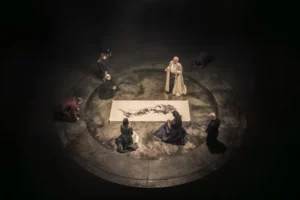
There were several touches such as the beautiful opening tableau, and a piece of doubling that reinforces the idea that the fates are against the star-crossed lovers, that I’ve never seen done this way before, but make perfect sense, illuminating the story from within.
In a play that really lives or dies in the key casting, it’s great to see younger actors than is sometimes the case in the title roles – on top of which, Zoë West and Alicia Ford are simply breathtaking as Romeo and Juliet respectively, regardless of age.
Joe Alessi brings an earthy grittiness to the role of Capulet, his every impulse transmitted with a clarity and presence that’s mesmerising, whilst in Eithne Browne’s capable hands it is easy to see how the Friar ends up caught like a fly in the spider’s web of her own disastrous plan – though [400-year-old spoiler alert!] it’s Romeo and Juliet who pay the ultimate price.
Ebony Feare makes the Nurse a more fully rounded character than is often the case, with Milo McCarthy and Kelise Gordon-Harrison doing similarly sterling work as Tybalt and Benvolio respectively.
Elliot Broadfoot is a fine enough Mercutio not to need any pratfalls beyond his first, though the rest of the audience enjoyed the ‘more is more’ approach.
The use of music both live and recorded throughout is impeccable, with several actors proving to have voices to cherish. Costume, set and lighting also impress.
If I’m being really, really picky, I’d say there are a couple of moments of ‘overlap’ (for want of a better term) that didn’t quite work for me; but what would the point be in being picky in the face of such glorious storytelling? Hurt is a far better Director than I am a critic, so her vision trumps mine in any case.
I’m usually agnostic at best about non-Shakespearean interjections being added, not out of some misplaced ideal of purity, but because the bard simply doesn’t need it; but here they’re used wisely and judiciously, adding to the feeling of ‘nowness’ which really makes the play sing.
I’ve seen several really good productions of this, perhaps Shakespeare’s greatest tragedy; I can’t recall any that was quite so successful in making it seem like the play might have been written yesterday.
I’d have to compare the text of the original to that of this particular production to know precisely what input Dramaturg Tommo Fowler had in helping achieving this, beyond streamlining things and amalgamating a couple of characters; but even if that was all he did, it worked beautifully.
With the run ending on Saturday October 4th, there’s still time to get tickets, if you’re quick. I strongly recommend doing so; you won’t be disappointed.

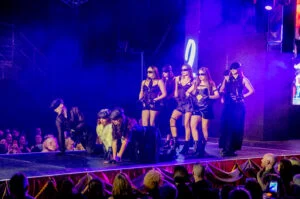
House of Suarez at 20: A Fabulous Act of Defiance in a World Gone Dark
House of Suarez Runway 20th Anniversary: Invisible Wind Factory, Liverpool 20 years is a long time. Especially in the fickle world of